
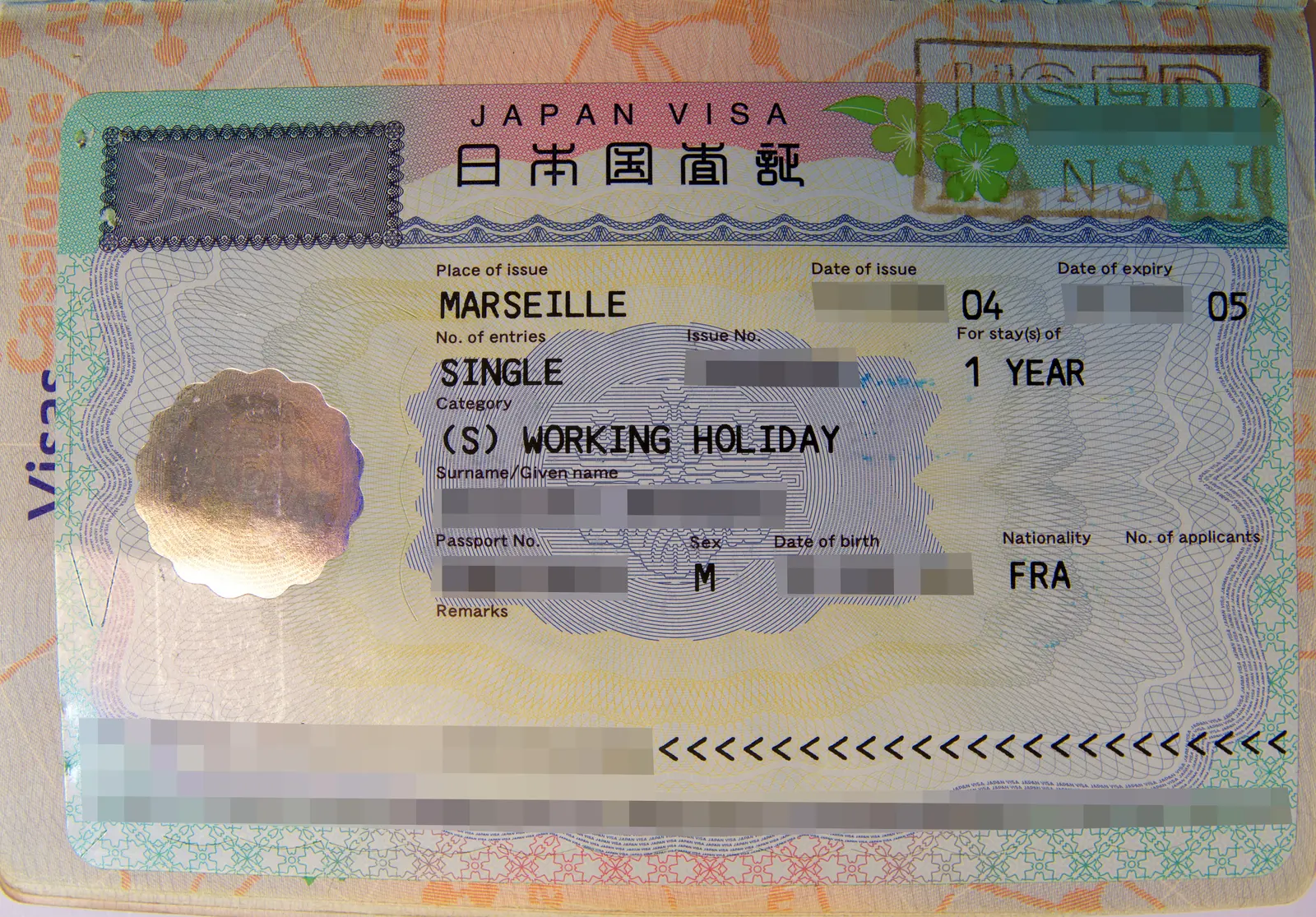
A working-holiday visa in a French passport, issued in Paris in 2004 and photographed in 2016. It is not the Digital Nomad visa.Photo: MathieuMD · Public domain
Remote work · Other ways to stay
The Digital Nomad visa and the other ways to stay
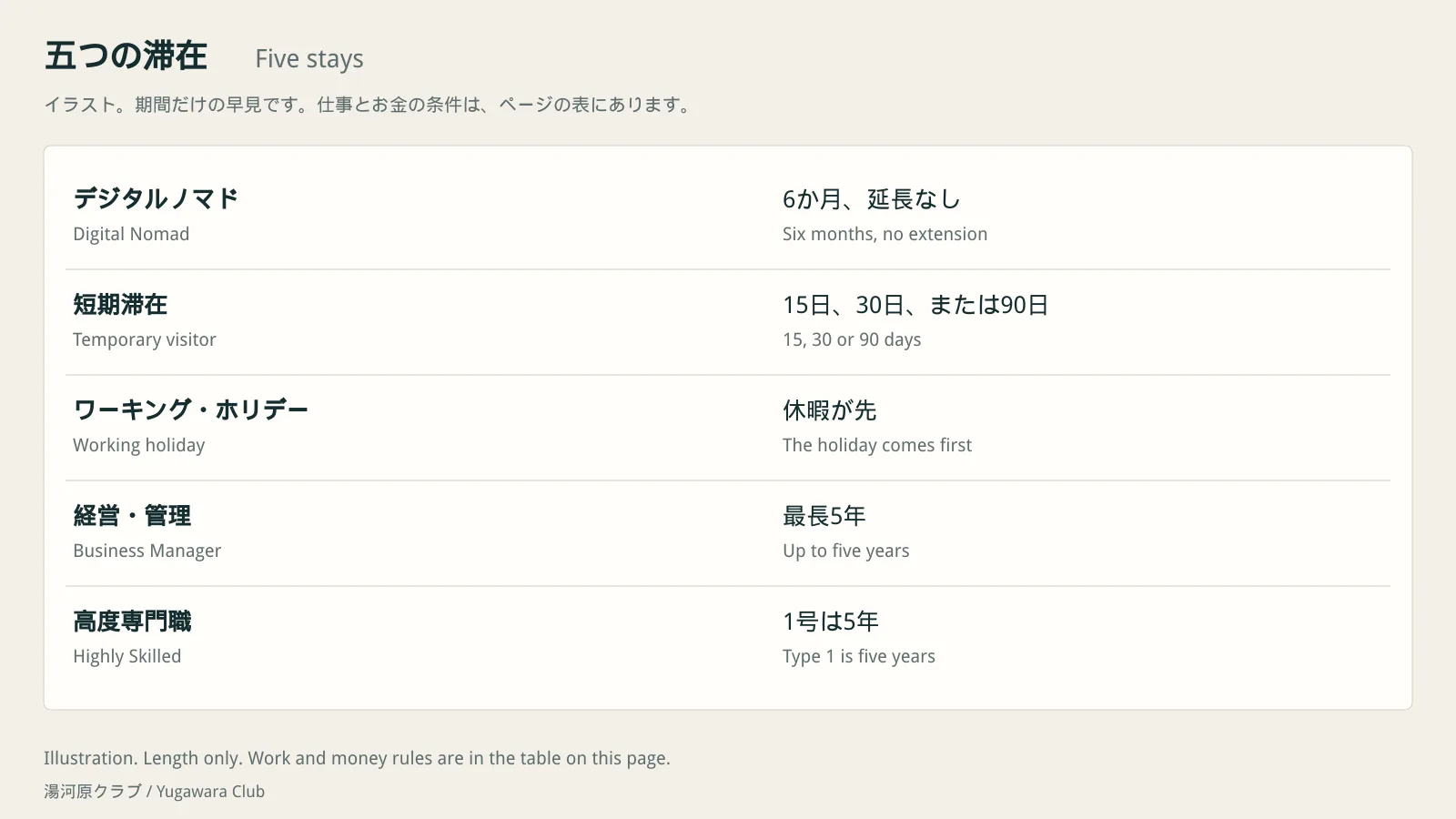
Japan's Digital Nomad visa is six months of remote work for people outside Japan. A short visit, a working holiday (ワーキング・ホリデー), Business Manager (経営・管理) and Highly Skilled Professional (高度専門職) are different stays. The length, the work and the money rules below are the ones those offices publish.
Five stays, side by side
Read across for how long you can stay, what work is allowed, and what the money rule is. The notes under the table are the parts that do not fit in a cell. The short-stay row uses the visa-exemption page. The digital-nomad row uses the Ministry of Foreign Affairs and the Immigration Services Agency.
| Stay | How long | Work | Money |
|---|---|---|---|
| Digital Nomad visa | Six months. No extension. After you leave, six months before you apply for the same status again. | Remote work for a foreign employer, or paid services and sales to people outside Japan, using information and communication technology. Not a job or a contract with a Japanese public body, a Japanese company, or a person in Japan. | Annual income of at least ¥10 million when you apply. Private medical insurance covering death, injury and illness, with treatment cover of at least ¥10 million. |
| Temporary visitor, visa-exempt | 15 days for Indonesia and Thailand, 30 days for Brunei and Qatar, 90 days for the other visa-exempt countries and regions. A few bilateral arrangements allow up to six months, and a stay past 90 days needs an extension before the first period ends. | Tourism, business visits, friends and relatives, and other activity that is not paid. A visa-exempt stay of 90 days or less is for people who will not do income-earning work. | No income figure is published for this stay. |
| Working holiday | A holiday of a set length under each arrangement. Where the ministry describes a second stay, it describes one-year stays. | The purpose is the holiday. Paid work is allowed only as a side activity, to add to your travel funds. Bars, cabarets, nightclubs, gambling places and other premises affecting public morals are prohibited. | No ¥10 million rule. A return ticket, or the funds to buy one, and reasonable funds for the start of the stay. |
| Business Manager | Five years, three years, one year, six months, four months or three months. | Running a business in Japan, or managing one. Trade is the example the status table gives. This is not remote work for an office abroad. | For a new application, the criteria in force from 16 October 2025 include capital or total investment of ¥30 million and at least one full-time employee. |
| Highly Skilled Professional | Type 1 (高度専門職1号) is five years. Type 2 (高度専門職2号) has no time limit, after three years or more on Type 1. | Research, specialist work, or business management, under a contract with a public or private organization in Japan. The points total has to be 70 or more. | Annual income is one of the points, with education and career. There is no single yen line in place of the 70 points. |
Against a working holiday
A working holiday is a holiday first. The work tops up the travel money, and it can be work in Japan, which the Digital Nomad visa does not allow. The Digital Nomad visa is the other way round: the work is the point, and it has to be for people outside Japan, with an income of at least ¥10 million already earned.
You are 18 to 30, inclusive, when you apply. For Australia, Canada, South Korea and Ireland the published band is 18 to 25, unless that country and Japan extend it to 30. Dependents and children cannot come with you. You need a passport of that country or region, and you have to be in good health. For most partner countries you also have to be living there when you apply. As of 1 April 2026 the programmes run with 32 countries and regions. Some of them, named on the ministry's page, can be taken twice in a lifetime, and those notes describe the stays as one year.
Participants visit the municipal office where they live and notify their address within 14 days of settling. The digital-nomad questions say that moving from town to town needs no special procedure.
Business Manager and Highly Skilled Professional
Business Manager is for a business you run or manage in Japan. From 16 October 2025 a new application also needs either three years of management experience, including a business-preparation designated activity, or a master's-level degree in management or in the field of the business. The applicant or the full-time employee needs a substantial level of Japanese. The notice has CEFR B2 in mind. A person with expert knowledge of management has to review a new business plan, with an exception at listed-company scale. The full-time employee is a Japanese national, a special permanent resident, or a person on a Table II status: permanent resident, spouse of a Japanese national, spouse of a permanent resident, or long-term resident. Someone already on Business Manager when the criteria changed is not refused a renewal for three years only because the new criteria are missed, and after that the decision looks at the business as a whole. The periods of stay are on the status table.
Highly Skilled Professional is a points status for work with an organization in Japan: academic research, specialist and technical work, or business management. Seventy points, from education, career, annual income and the other published items, is the line. Type 1 is granted for five years. Type 2, with no fixed period, is for someone who has done the Type 1 activity for three years or more. Preferential treatment includes a spouse who can work, parents in some cases, and a faster landing process. It is not a status for remote work paid from abroad. The application page is separate from the digital-nomad one.
- How to apply for the Digital Nomad visa
- The documents and the fee, if this is the status you want.
- Eligible countries
- The Digital Nomad chart. The other statuses use their own rules.
More on working from Yugawara
- An onsen town for digital nomadsA workation near Tokyo: the visa, a room, a desk and a bath, 75 minutes from the city.
- The Digital Nomad visa, and YugawaraSix months in town on Japan's designated-activities visa, and what the missing residence card changes.
- Where to stay as a nomadMakuyama House by the river for a month, then Shiroyama Bekkan and the share house.
- Places to work fromCafés, free desks and a booth for calls, with hours and prices.
- A day in the life of a nomadAn example Tuesday: a café desk, lunch at West, a call, and Kogome no Yu for ¥600.
- Coworking and wifi in YugawaraFree desks in Man'yō Park and by the station, a lounge with a bath, and the library.
- Long stays and monthly rentals in YugawaraA whole house by the river, a share house above the station, monthly flats, and the town's grant for movers.
- Onsen and work: a day in YugawaraWhich bath to use when, what it costs, and where to shop for the week.
Quick answers
- How is Japan's Digital Nomad visa different from a working holiday?
The Digital Nomad visa is six months of remote work for people outside Japan, with income of at least ¥10 million, and no extension. A working holiday is a holiday first, with work only to add to your travel funds, including work in Japan, and the ministry's notes on a second stay describe one-year stays.
- Can I do the remote work on a 90-day visa exemption?
No. A visa-exempt short stay is for people who will not do income-earning work. Paid work needs a status that allows it.
- Is Business Manager a way to do the same remote job?
No. Business Manager is for running or managing a business in Japan. From 16 October 2025 a new application includes capital or investment of ¥30 million and at least one full-time employee.
Sources
This is not legal advice.
- Immigration Services Agency: Digital Nomad and family
- Immigration Services Agency: questions and answers, July 2024 (PDF)
- Ministry of Foreign Affairs: the digital nomad visa
- Ministry of Foreign Affairs: visa exemption, 1 September 2025
- Ministry of Foreign Affairs: visa questions
- Ministry of Foreign Affairs: short stay and work or long-term stay
- Ministry of Foreign Affairs: working holiday programmes, 1 April 2026
- Immigration Services Agency: status of residence table
- Immigration Services Agency: Business Manager
- Immigration Services Agency: Business Manager criteria from 16 October 2025 (PDF)
- Immigration Services Agency: Highly Skilled Professional points
- Immigration Services Agency: Highly Skilled Professional application
Last checked 22 October 2026.