
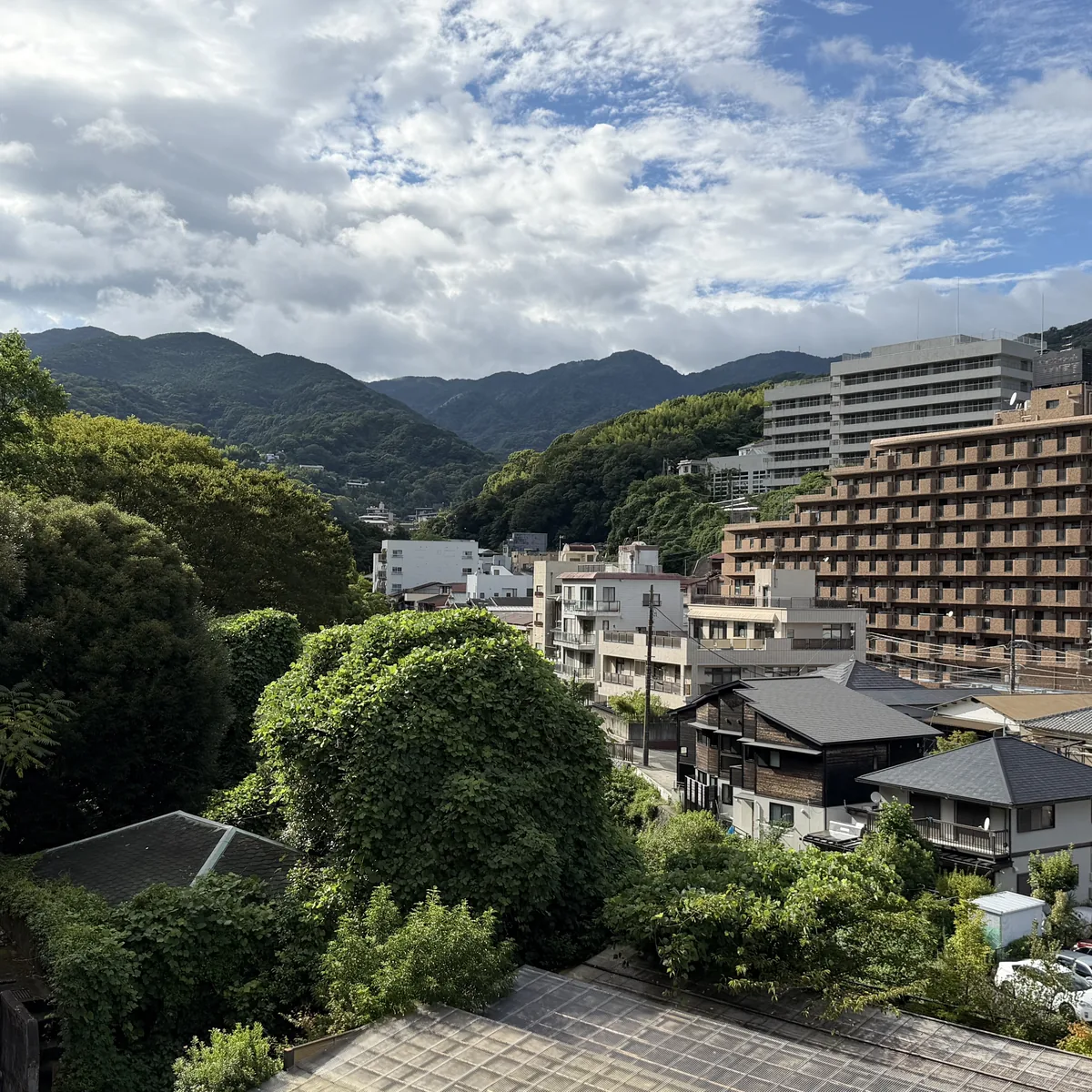
Where the troop is reported
Yugawara has one troop of Japanese macaques, and it lives in town. The town says the T1 troop, about 20 monkeys, is now the only troop in the Seishō area, and that it is active mainly in the onsen district, Miyakami, Miyashita, and Shirohori. That is the valley most visitors walk up from the station to the inns, and the streets around it; the dated sightings are kept on our Yugawara monkeys page. Knowing these names won't help you find monkeys, and isn't meant to. It tells you where to keep a bag closed and a window shut.
Kanagawa Prefecture draws the range a little wider. Its page says the troop uses farmland and built-up areas in Miyashita, Miyakami, Shirohori, Kajiya, and Yoshihama, uses Manazuru, and sometimes appears toward Izumi in Atami. Izumi is across the Chitose River, which separates Yugawara Onsen in Kanagawa from Izumi Onsen in Atami, so on that bank you are in Shizuoka and Atami City's guidance applies. Our Yugawara, Hakone, or Atami guide explains where the border runs.
The town's household survey shows where the trouble lands. It drew 453 responses for 2025, and damage was still concentrated in particular districts: Miyashita had 47.0% of the damage reports, Shirohori 25.5%, Miyakami 12.8%, Chūō 4.3%, Kajiya 3.6%, Yoshihama 3.1%, the onsen district 2.7%, and Kadokawa 0.5%, with none from Okuyugawara, Kawabori, or Fukuura. Those are shares of damage reported by households, not counts of monkeys or sightings. That is why the onsen district, which the town names first, has a small share: its streets are mostly inns and shops, and the survey counts homes.
When they turn up
Expect them at any time of year. The town's earlier guidance says wild monkeys appear frequently all year round, and the prefecture's plan for the troop notes that in summer it uses Yoshihama in particular. On the Atami side, Atami City says the monkeys appear in Izumi mainly from early spring to autumn, March to October. Nobody publishes a timetable. One shop owner told FNN that the entrance to the onsen district is a monkey route, usually around 2 pm and sometimes around 4 pm, which is one person's experience rather than a schedule. In the evening the troop heads for shelter: the town says empty houses scattered through town are being used as night roosts, and TV Asahi reports that the prefecture and the town chase the monkeys in the evening with firecrackers to stop them going back to those houses, with little effect.
Most encounters end with a monkey on a roof and a person walking on, but not all. On the morning of 17 September 2026, a man walking on the road in front of an inn was surrounded by more than ten monkeys and bitten, with minor injuries, and FNN reports that he was a resident in his forties who was taken to hospital. The town and the prefecture have since fitted GPS collars to the troop's two leading monkeys, and the patrols use them to follow the group. Nippon TV's report from that morning is below.
News report
The morning of 17 September
Nippon TV's short report on the man bitten on the road in front of an inn in Yugawara's onsen district. In Japanese.
Produced by: Nippon TV News ↗
If you meet one on the street or a trail
The town's advice fits in a breath: don't go near a monkey and don't meet its eyes, and back away without turning your back. TV Asahi explains why the eyes come first: a monkey can take eye contact as a threat and attack. So stay calm and move away slowly. Don't chase one or run after it, and leave it a clear way out.
Food is what the monkeys are after, so keep it out of sight. Close your bag, don't eat on the move where the troop is about, and never hand anything over: the town asks you not to feed monkeys or leave anything edible outdoors, because once monkeys learn the taste of human food they start snatching it from people and settle in town instead of going back to the hills. Keep children beside you; the town says some monkeys threaten and harm women, older people, and children. Take a photo from where you are, if at all, because the town asks people not to take risks to film a monkey. And don't try to trap or corner one: Kanagawa lists the Seishō monkeys as wildlife at risk of extinction, and catching them without permission is prohibited. Our guide to living with the T1 troop has more on what the troop is and why it behaves this way.
At an inn, a rental, or a share house
Monkeys open doors. The town says they open sliding doors and screen doors and come inside, so lock them, and close the lace curtains so food in the room can't be seen from outside. The prefecture adds that closing the curtains so nobody can see in works even better. Leave nothing edible on a balcony or terrace. Atami City's advice holds on this side of the river too: monkeys climb quickly to balconies and roofs using gutters, so don't open a window to watch them.
Inns deal with this as well. In a June 2026 request to the prefectural assembly, the town council wrote that inns have had to close outdoor baths and disinfect rooms the monkeys got into to keep guests safe, and one 2025 survey entry reads simply: it appeared near the outdoor bath, so we had to close it. If the staff close the open-air bath for an hour or ask you to keep the windows shut, that is the reason. Ask at the front desk if you're unsure. Our places to stay and onsen guide list where to sleep and bathe.
If you live or host here
Most of what draws the troop into a street is food left within reach. The town asks owners to harvest fruit trees and vegetables early, even before their best moment. The prefecture's plan says that crops left in the field, abandoned fruit trees, and discarded fruit have the same effect as feeding, and asks homes and shops to never leave food waste outdoors, to harvest garden fruit, and to manage the food in their shops. The 2025 survey shows what happens otherwise. Households recorded 2,100 reports of monkeys on the roof making noise, 177 of gutters, TV aerials, or screens broken, 166 of monkeys coming into a house or shop without damage, and 146 of things taken or broken indoors. People were threatened 267 times and chased 72 times. These are survey counts, not separate incidents.
Tell the town when it happens. Its macaque page has two online forms, one for damage to crops and one for injuries, threats, and sightings. By phone, call the town office on 0465-63-2111 and ask for the Environment Division, extensions 551 to 553, or the Agriculture, Forestry and Fisheries Division, extensions 733 and 734. The town also welcomes photos and video sent by the person who took them. The firecrackers the town hands to residents, the email addresses for photos, and the rest of the details are in Firecrackers from the Town, and the history of the patrols is in Twenty Years of Chasing Monkeys in Yugawara.
Why feeding is the line
The troop is in town partly because people once fed it. The prefecture says feeding for tourism and other reasons made the population grow, and its plan for this year says deliberate feeding makes monkeys used to people and less wary of them, which it calls a major cause of damage spreading and of monkeys settling in an area. Yugawara's part of the plan is to make sure residents and others know not to feed them, and a prefectural handout says the town keeps up its awareness work on feeding by tourists. The bigger argument is still open. The town council has asked the prefecture to act on the premise of capturing the whole troop, and the prefecture has told TV Asahi that the Seishō population is endangered in its Red Data Book and the T1 troop is the last group, so it is considering the question carefully. That is a request, not a decision. Whatever comes of it, one snack from a visitor makes the problem worse for the people who live here.
A good encounter
Yugawara's monkeys are a fact of life in the valley, and the places they turn up are the places you'll walk anyway: the onsen district, Miyakami, Miyashita, and Shirohori. Walk them the same way, with your food packed away, your eyes somewhere else, and your room locked behind you. A good encounter is a monkey on a wall and a person who carries on up the hill. For more, read the T1 guide, Masato, the Monkeys, and the Yugawara Behind the Brochures, and the rest of our wildlife stories.