
Steam over the Fujiki River
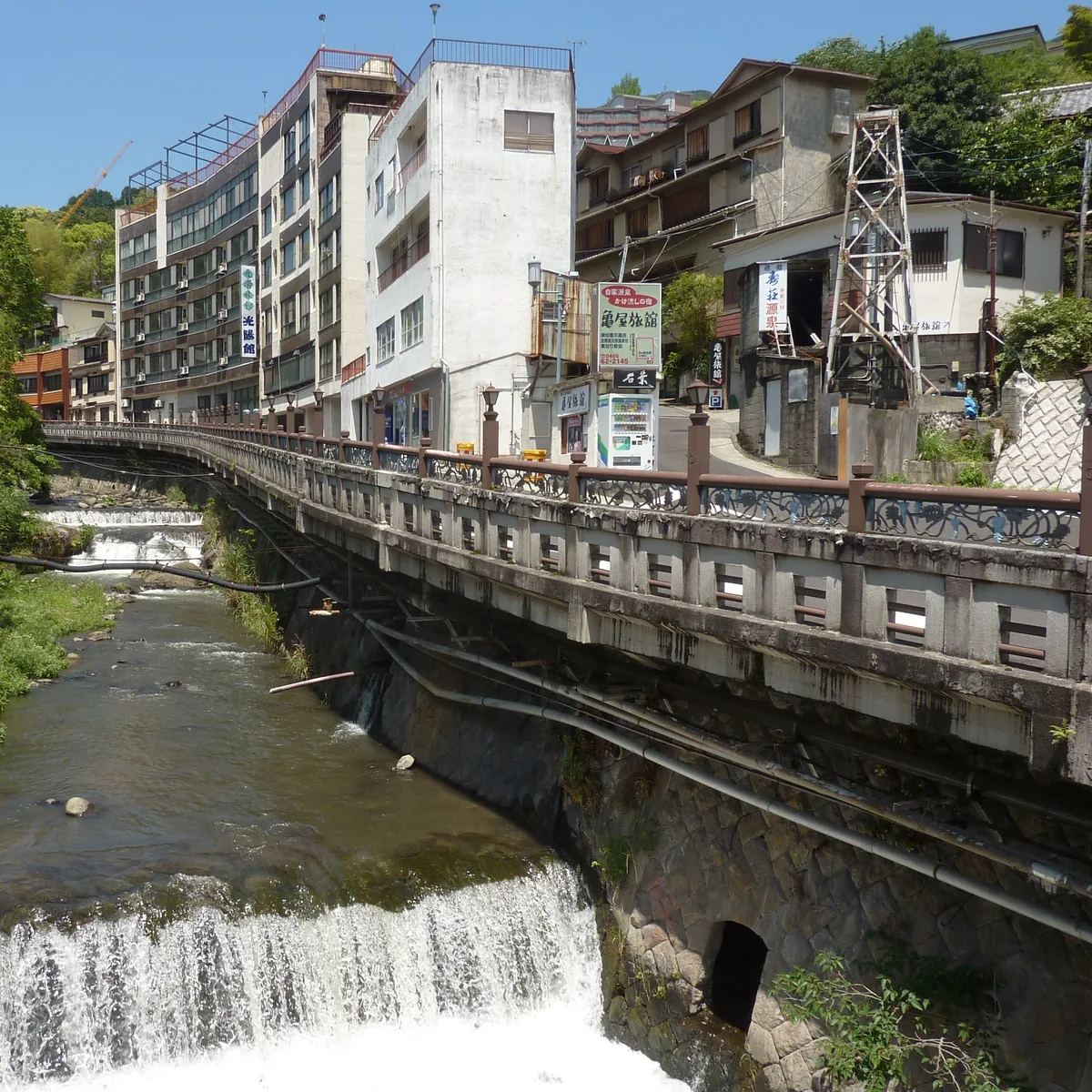
Walk up the Fujiki River through Yugawara's onsen district and you will notice steel towers standing over wellheads, and pipes fixed along the walls of the river. They are easy to walk past on the way to a bath. They are also the clearest sign of how this town actually works, because for dozens of Yugawara's inns the hot water does not come from a spring under the building. It travels there through a network the town has run for almost seventy years.
Yugawara did not become an onsen town all at once. Hot water rising through a riverbed put the valley into Japan's oldest poetry anthology. Three later changes turned it into a modern spa town: wounded soldiers sent here to recover from 1895, drilled wells from 1909, and the railway in 1924. The part most visitors never see came last. In 1956 the town set up its own onsen service, which buys water from privately owned springs, pools it, and pipes it to inns and homes. It did that because by the 1950s too many wells were pumping too hard, and the springs were giving out.
A spring in the riverbed
The story starts with a love poem. Book 14 of the Man'yōshū, the eighth-century poetry anthology, includes an anonymous poem, number 3368. In English it runs roughly: "Like the hot water rising in the valley of Doi in Ashigara, she never once says that it will end." The Nara Prefecture Complex of Man'yō Culture, which keeps the standard online database of the anthology, places Doi no kōchi in the Yugawara valley along the Chitose River. Yugawara's town history chronology lists the poem under the year 759, and the anthology was finished around 770.
The Man'yōshū names other hot springs, all in western Japan: Dōgo in Ehime, Arima in Hyōgo, Shirahama in Wakayama, and Futsukaichi near Dazaifu in Fukuoka. Yugawara is sometimes described as the only hot spring in the anthology. It is the only one in eastern Japan. The onsen historian Ishikawa Michio, writing for the Yugawara Onsen Tourism Association, draws the conclusion from that: Yugawara has the oldest written record of any hot spring in the Kanto region.
Doi was the old name for this stretch of coast, covering what are now Yugawara and Manazuru. The local Doi clan backed Minamoto no Yoritomo when he raised his army, which is why their temple and castle site still anchor the Shiroyama walk. Ishikawa writes that in the medieval period warriors and villagers came here to bathe and heal, especially after battle wounds or the injuries of local stonecutters, and that the waters were known as Kogome no Yu or Koume no Yu. That reputation as a bath for wounds would count for a great deal again centuries later.
Ishikawa's account of the Edo period is short and specific. The first record he cites is the Odawara lord Inaba Masanori bathing here in 1651. In 1672 the hot-spring area became Miyakami village, and the name Yugawara appears in the village register for the first time, which is where "Yugawara Onsen" comes from. Because the water came up through the riverbed, every flood shifted the springs. Three shared bathing pools dwindled to one, which villagers called the mura-yu, the village bath, and treated as common property. An 1842 gazetteer of Sagami Province shows three pools; the stone-walled lower one was also called the sōyu, a bath run by the whole community. On the Edo onsen ranking charts, set out like sumo rankings, Yugawara held third rank on the eastern side.
Soldiers, writers, and a railway pushed by hand
Modern Yugawara begins with war. From 21 June 1895, soldiers wounded in the Sino-Japanese War, first treated at the army reserve hospital in Tokyo, were sent to Yugawara to convalesce. The town chronology counts 1,260 officer patient-days and 30,491 for other ranks between that June and 30 November. Wounded soldiers from the Russo-Japanese War followed from June 1904. Ishikawa writes that these designations spread Yugawara's name as a healing bath across the country.
Getting here was the hard part. In July 1895 the Zusō Jinsha Tetsudō opened between Atami and Yoshihama: a railway on which men pushed the passenger cars by hand. It reached Odawara in March 1896, and the full run took about four hours. It was an Atami to Odawara line that passed through the area rather than a Yugawara company, and the Great Kantō earthquake of 1923 cut the track. It was never rebuilt.
Writers came anyway. Kunikida Doppo stayed at the Nakanishiya inn and published "Yugahara yori" (From Yugahara) in 1902; a stone in Man'yō Park carries a line of his about heading into the Yugawara valley feeling like walking deep into the clouds. Natsume Sōseki stayed at the Amanoya from 9 to 16 November 1915.
Drilling down
Until the twentieth century, Yugawara bathed in whatever the river gave it. In February 1909 a man named Murobuse Katsuzō sank a successful trial well using kazusa-bori, a traditional hand-boring method, and after that wells went down one after another along the Fujiki River gorge. By 1913 there were twenty, packed into the onsen district and mostly 50 to 100 metres deep. The 1923 earthquake added more: the chronology notes hot water breaking out at several sites in its aftermath.
Then the trains arrived properly. On 1 October 1924 the Atami Line reopened from Nebukawa to Yugawara and Yugawara Station opened. In 1926 Doi village renamed itself Yugawara town. When the Tanna Tunnel opened on 1 December 1934, the line through Atami became the Tōkaidō Main Line, and Yugawara sat on the country's main railway. In 1955 Yugawara merged with Yoshihama and Fukuura to form the present town.
Too many wells
Success brought the problem. The town's own account is blunt: in the 1950s, indiscriminate drilling and over-pumping caused water levels to fall sharply, and depletion became a serious threat. In 1956 Yugawara founded a municipal onsen service to protect the resource and share it properly. That year it laid a 1,800-metre open wooden channel. The next year, spring owners and the town pooled 13 springs supplying 1,850 litres a minute, and water began flowing to 190 users in April 1957.
The wooden channel was planned to last ten years. It corroded and broke far sooner, and the longer the pipe, the cooler the water by the time it arrived. From 1965 the town rebuilt the network with asbestos-cement pipe and turned the main into a loop so that water left over after delivery could be used again. On 22 July 1966 Kanagawa designated Yugawara a special onsen protection area.
Private springs, public pipes
The arrangement at the centre of it all is unusual, and the town describes it as unique. The springs stay in their owners' hands. Each owner pumps water at their own responsibility into the town's main, the town buys it, and the town distributes it. A committee of twelve oversees the service: the mayor, four spring owners, four users, and three outside experts.
Pooling the water did not solve everything. A 1986 study found leaks, failing insulation, and a system that had kept up with demand by pumping harder, which wore down individual springs. The town drew up a centralized management plan that year and switched supply to metered use with limits on pumping; centralized management began in 1994. Around 1996, water levels in six springs the town tracks began rising, and they steadied after 1998, helped by about 2,000 millimetres of rain a year. The town treats that as a spot check, not proof for the whole district. Today the onsen section watches tank levels, flow, and temperatures from monitors in the town office.
The figures for fiscal 2024 show the scale. The town registers 157 springs, of which 75 are in use. Twenty-five springs feed the town system, delivering 1,790 litres a minute at an average of 70.3 °C. The town owns 11 springs itself. At the end of that year the system supplied 46 hotels and ryokan, 23 company dormitories and retreats, 133 private homes, and 28 other users. With 75 springs in use and only 25 feeding the town pipes, plenty of baths in Yugawara still run on their own wells.
Is it working? Kanagawa's Hot Springs Research Institute, the prefecture's onsen research body, says most of Yugawara's springs are drilled inside the eroded caldera of the Yugawara volcano, which stopped erupting several hundred thousand years ago. It counted 108 springs at the end of fiscal 2024, about 18 percent of the prefecture's total, and ranks Yugawara second in Kanagawa after Hakone. The town's own table also comes to 108 once the 49 springs it lists as suspended are left out. The institute's 2024 survey of 91 springs found no fall in temperature or dissolved minerals since 1962 that would point to depletion, and it still recommends watching the springs closely. The town, for its part, still warns that deep drilling for onsen-equipped housing puts the resource at risk. Both are true at once: the system appears to have steadied the springs, and nobody involved treats them as safe to take for granted.
Video
Inside the institute that watches the springs
Kanagawa Prefecture's own introduction to the Hot Springs Research Institute, the body that surveyed Yugawara's springs in 2024. In Japanese.
Produced by: Kanagawa Prefecture official channel ↗
Seeing the history on a walk
You can trace most of this on foot from the onsen district. Man'yō Park was named at the suggestion of the poet Sasaki Nobutsuna because of the poem, and its poem stone carries his selection in the hand of the painter Takeuchi Seihō; the Doppo stone is nearby. Beside the park, the town's day bath is called Kogome no Yu, the medieval name for these waters, and Soyu Terrace takes the name of the old shared bath. Walk along the Fujiki and you will see the wellhead towers; along the Chitose, the pipes. The Chitose is also the prefectural border, so the inns on its far bank are in Atami's Izumi district, Shizuoka, not in Yugawara.
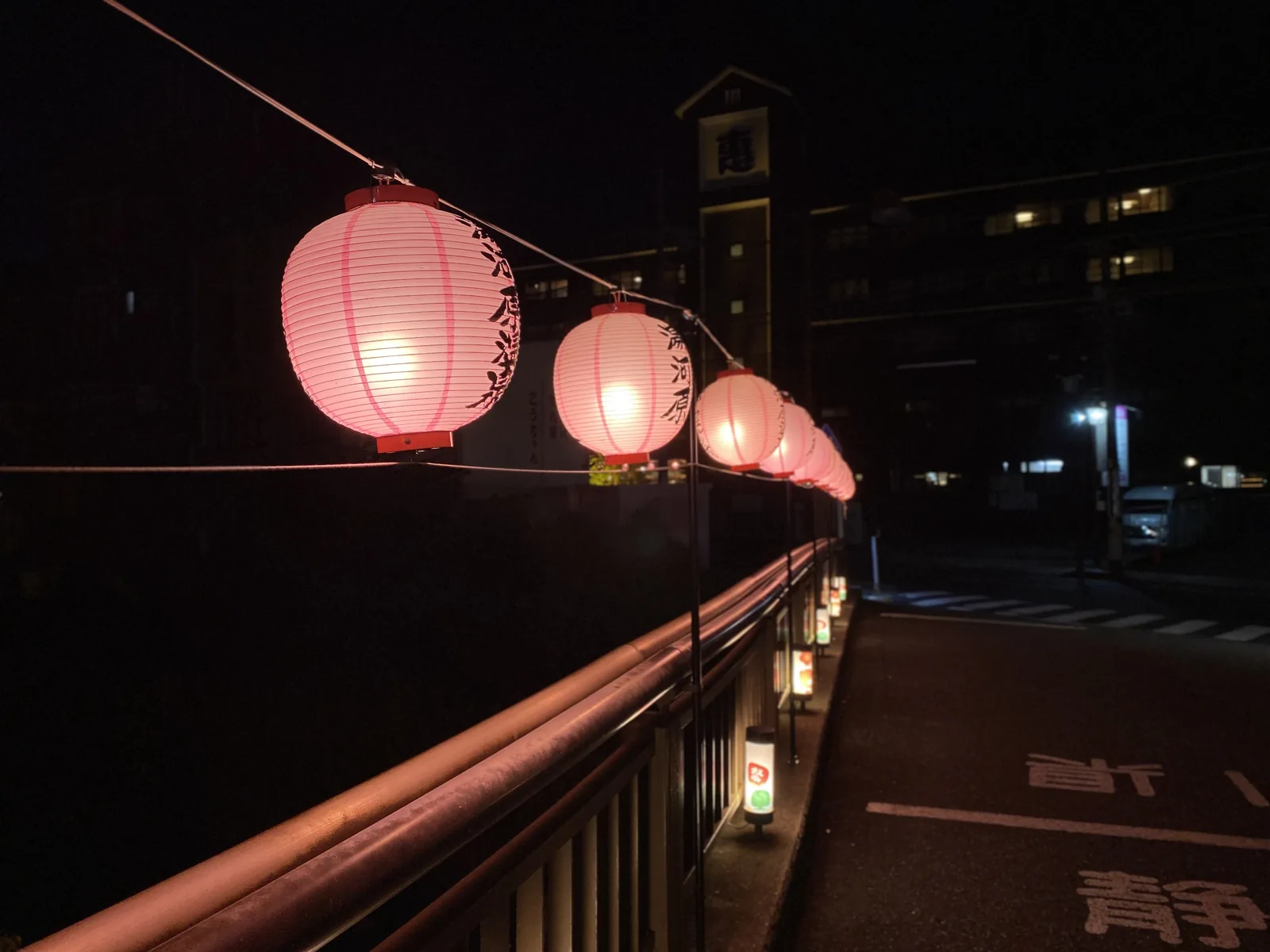
When you sink into a bath at an inn on the town system, you are in water from privately owned wells that the town has pooled, piped, and watched over since 1957. The village bath in the 1842 gazetteer was shared because the river kept moving the springs. The water is still shared today, for a different reason: the springs only last if the whole valley uses them carefully.
News report
The onsen town today
Nippon TV's news every. on Yugawara in January 2024. By the broadcaster's count, more than 1.3 million people a year came at the peak and fewer than half that in 2022, and the report follows the town's push to bring younger visitors back. In Japanese.
Produced by: Nippon TV News (NTV) ↗