
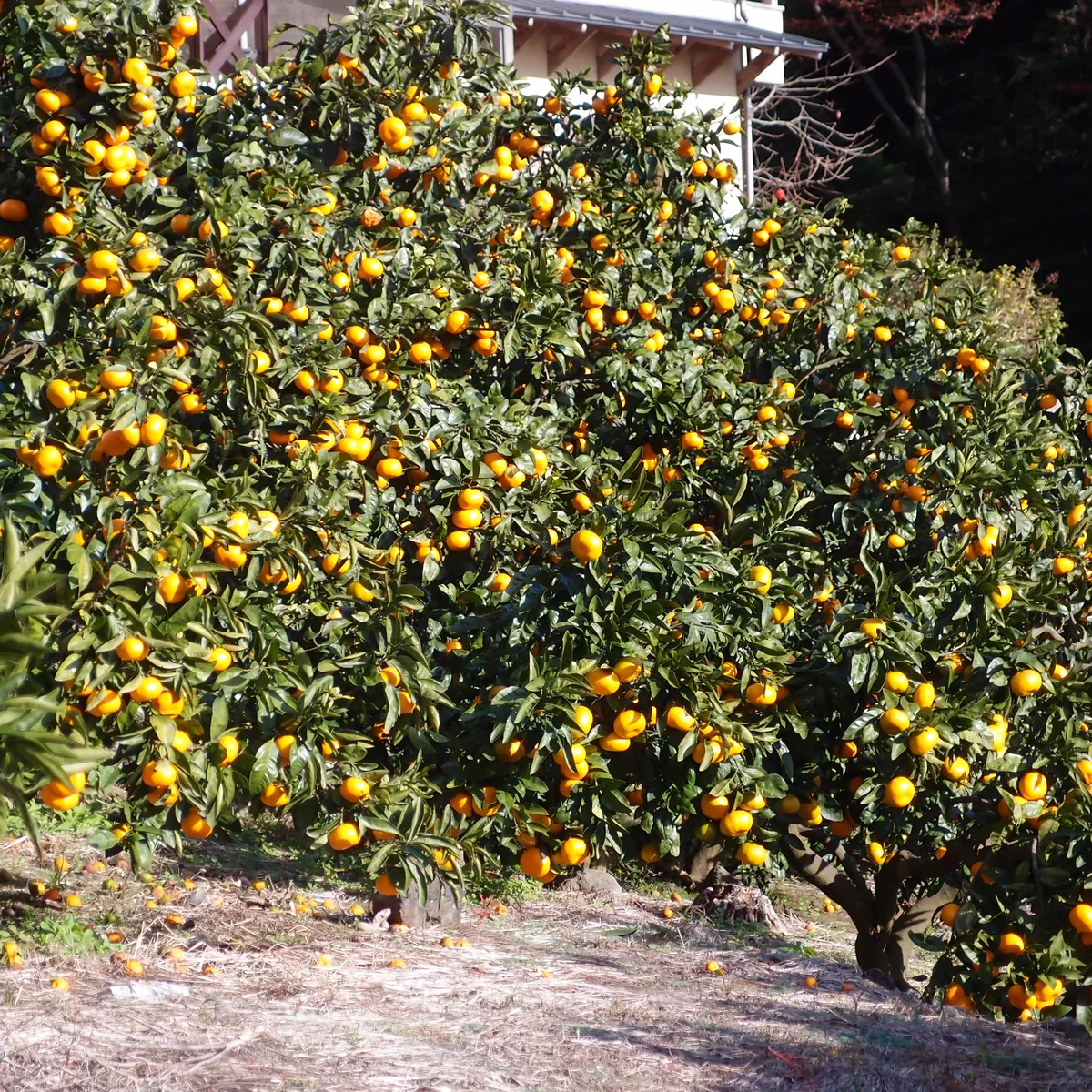
Orange on the hillsides
From the window of a Tōkaidō Line train, the hills above Yugawara are stepped and dark green, and from October they are dotted with orange. Yugawara's volunteer guides say the view calls to mind the old children's song about a hill of mikan blossoms. The town takes the fruit seriously: the mikan is the town flower, and the town crest stylises a cut mikan with the hot spring. If you came for an afternoon of picking, our mikan picking guide has this season's dates, prices, and pickup. This article is about the fruit itself.
Yugawara's fruit story is a citrus story. Its slopes were terraced for citrus, a local grower bred a mandarin that is still one of western Kanagawa's main varieties, and the season runs most of the year because growers plant many kinds side by side. Persimmons, loquats, and chestnuts are a different thing here. They grow mostly in gardens and on the edges of fields rather than in commercial orchards, and in a town that shares its hills with a troop of wild monkeys, the most useful thing to know about them is that the town asks owners to pick them early.
A citrus town
Before 1955, Yugawara was three communities. The town's statistics book says they were known as Yugawara the resort, Yoshihama the farming town, and Fukuura the fishing village, and the three merged on 1 April 1955. On these hills, farming came to mean citrus. Local guides trace it to the Edo period, when the warm hills turned to mikan for a living. A Yugawara grower interviewed in a farm magazine calls the stepped fields one of the area's signature landscapes, held up by layer upon layer of stone walls, built from rock dug out as the slopes were cut flat. Tanizaki Jun'ichirō's last home stood on the Yoshihama hill, among the mikan orchards, and the guides still quote his poem about a single mikan blossom at dusk that even old eyes can see, like a star.
Walk past those walls and you will not find one kind of tree. Local guides say more than 80 kinds of citrus, led by unshū mandarins, can be had over the year. Growers plant for a long season. The grower in that interview farms 175 ares of citrus, 100 of them Ōtsu No. 4, plus four other kinds that ripen at different times, so the farm earns all year. That is 1.75 hectares, a family-sized holding by any measure. The guides add that Yugawara mikan peaked in the late 1960s, and that variety improvement turned a sour fruit sweet.
The orchards are shrinking. In the national farm census, as printed in the town's 2026 statistics book, Yugawara had 329 farm households in 2005 and 173 in 2020, and its orchard land fell from 178 hectares to 101 over the same years. The town's plan gives the reasons. Most farmland is on slopes, where machines are hard to use and production is hard to expand, and while mikan prices are slowly rising, farm finances are still tight. Farm numbers are falling and farmers are ageing. The town's regional strategy notes abandoned land, such as old mikan fields, increasing year by year, and proposes turning some of it into community plots or flower fields.
Mandarins with a Yugawara story
Two mandarins carry a Yugawara story. The better documented is Ōtsu No. 4. Yamaguchi Prefecture's citrus growing guide lists its breeder as Ōtsu, a grower in Yoshihama, Yugawara, who raised it from a nucellar seedling of Jūman unshū, and describes the fruit as large, very flat, and even in size. That guide comes from the far western end of Honshu. Back home, Ōtsu No. 4 is still one of the main varieties, alongside Aoshima, that JA Kanagawa Seishō ships as Odawara and Ashigara mikan. In town you can drink it: a mikan juice named OHTSUNO.4 is on Yugawara's list of certified local products.
Local guides count Fujinaka unshū among the mandarins born in Yugawara, alongside Ōtsu No. 4. Shonan Gold is different: Yugawara grows it, but it was not bred here. The Kanagawa Agricultural Technology Center bred it and registered it in 2003, crossing Ōgonkan with Imamura unshū to turn the small, hard-to-peel Ōgonkan into a larger fruit that is easier to eat. The Yugawara grower says shipments began in 2006. Its season is short. The prefecture calls it a citrus with a one-month season, and JA Kanagawa Seishō puts it in March and April.
Video
Shonan Gold, from Kanagawa Prefecture
A short film from Kanagawa Prefecture's local-produce channel, Kanasan no Hatake, on Shonan Gold and the products made from it. In Japanese.
Produced by: Kanagawa Prefecture (Kana-san's Field) ↗
A year of citrus
Because growers plant so many kinds, there is local citrus for most of the year. The first comes from greenhouses: Odawara and Yugawara greenhouse mikan, mainly the Miyagawa early variety, ships from mid-August to early October. The open-field unshū ripen in autumn, which is when picking runs, from October to December. The Odawara and Ashigara pack, built on Ōtsu No. 4 and Aoshima, ships from mid-November into early March. Shonan Gold follows from mid-March to mid-April. Then the trees flower: mikan blossom opens in May, from just after the Golden Week holidays to the end of the month, and the scent hangs around the orchards.
Video
In the mikan fields and the packing house
JA Kanagawa Seishō, the farm co-op that runs Yugawara's JA farm shop, sends its mascot Kinjirō-kun into the mikan fields and the packing house to find out what makes unshū mandarins taste good. In Japanese.
Produced by: JA Kanagawa Seisho ↗
Some of the year's fruit ends up in jars and bakeries. Yugawara certifies local products under the name "made in Yugawara", and 35 products held the mark in 2026. The tourism association's feature lists several made from local fruit: a marmalade made only from natsumikan harvested in Yugawara and sugar, a jam of Yugawara-grown Aoshima mandarins, a cream bun topped with Yugawara lemons soaked in honey, and a juice pressed from ripe Yugawara kiwifruit. The town's own list adds an organic mikan juice.
Persimmons, loquats, and chestnuts: garden trees
Persimmons, loquats, and chestnuts tell a different story. The same census table shows how few farms grow them as crops: Yugawara had three or four persimmon-growing farms in 2010 and 2015 and none in 2020, one loquat farm in 2010 and 2015 and none in 2020, and one to three chestnut farms from 2005 to 2020, each on too little land to register as a hectare. Kanagawa's commercial persimmons and chestnuts come from elsewhere in the prefecture: Isehara and Yokohama for persimmons, and the hilly Tsukui area for chestnuts.
In Yugawara these are mostly garden trees, and each has its season and its use. Astringent persimmons are the usual fruit for hoshigaki, dried persimmons, not for eating straight off the tree. Loquats are an early-summer fruit. The ripe flesh is safe to eat, but Japan's farm ministry asks people not to eat powdered loquat seed. Chestnuts fall in autumn. In September 2026 Yugawara Yume Farm, a nonprofit that brings idle farmland back into use, held a chestnut-picking day with local children and neighbours.
Why the town asks for an early harvest
That garden fruit has another audience. Yugawara shares its hills with the T1 troop of Japanese macaques, and our guide to living with the T1 troop covers what to do if you meet them. For fruit trees, the town's request is simple: pick fruit and vegetables early, even if their best moment is still to come, and don't leave fruit or vegetable scraps outdoors, where they become food for wild animals. The town's own survey shows why. Its survey of monkey damage in 2025 drew 453 responses, and 318 entries were for fruit taken from garden trees. The town's damage-prevention plan lists loquats among the crops monkeys have damaged, along with mandarins and vegetables.
Kanagawa Prefecture's plan for fiscal 2026 sets out the next step: Yugawara will find the fruit trees that draw monkeys and notify their owners. If a tree on your land is heavy with fruit you don't plan to eat, picking it promptly helps your neighbours. The monkeys themselves are protected. Kanagawa lists the Seishō macaques as wildlife at risk of extinction, and capturing them without permission is prohibited. Everyone is asked never to feed them. And whatever the season, leave other people's fruit alone. Orchard trees, garden trees, and branches hanging over a road all belong to someone. Taking their fruit is theft under the Penal Code, and taking produce from forest land is forest theft under the Forest Act.
Where to buy it
The easiest place to taste the range is the Sunday morning market, held every Sunday from 6:00 to 9:00, rain or shine, at the entrance plaza of Man'yō Park and Yugawara Sōyu. The tourism association singles out its wide range of mikan. From the station, take an Okuyugawara or Fudō Falls bus about nine minutes to Ochiaibashi. JA Kanagawa Seishō's farm shop No. 1, at 4-1-1 Chūō, opens Monday, Tuesday, Thursday, and Saturday from 8:40 to 16:00, closes at 12:00 on Saturdays, and is closed on public holidays. There is also a farm shop in front of Yugawara Station, where the number of local farmers taking part has been growing. For jams, juices, and sweets, look for the "made in Yugawara" mark.
Yugawara's fruit is best the way the town sells it: bought from the people who grew it, at the market or the farm shop, or picked in an orchard that has opened for the season. The terraces are worth the train ride on their own, especially in May when the blossom is out and in late autumn when the hills turn orange. Walk the Shiroyama trail from the station and you pass citrus trees on the way up, like the one at the top of this page. Leave every tree you pass to the people who tend it. The less fruit left hanging or lying on the ground, the fewer reasons the monkeys have to come down.