
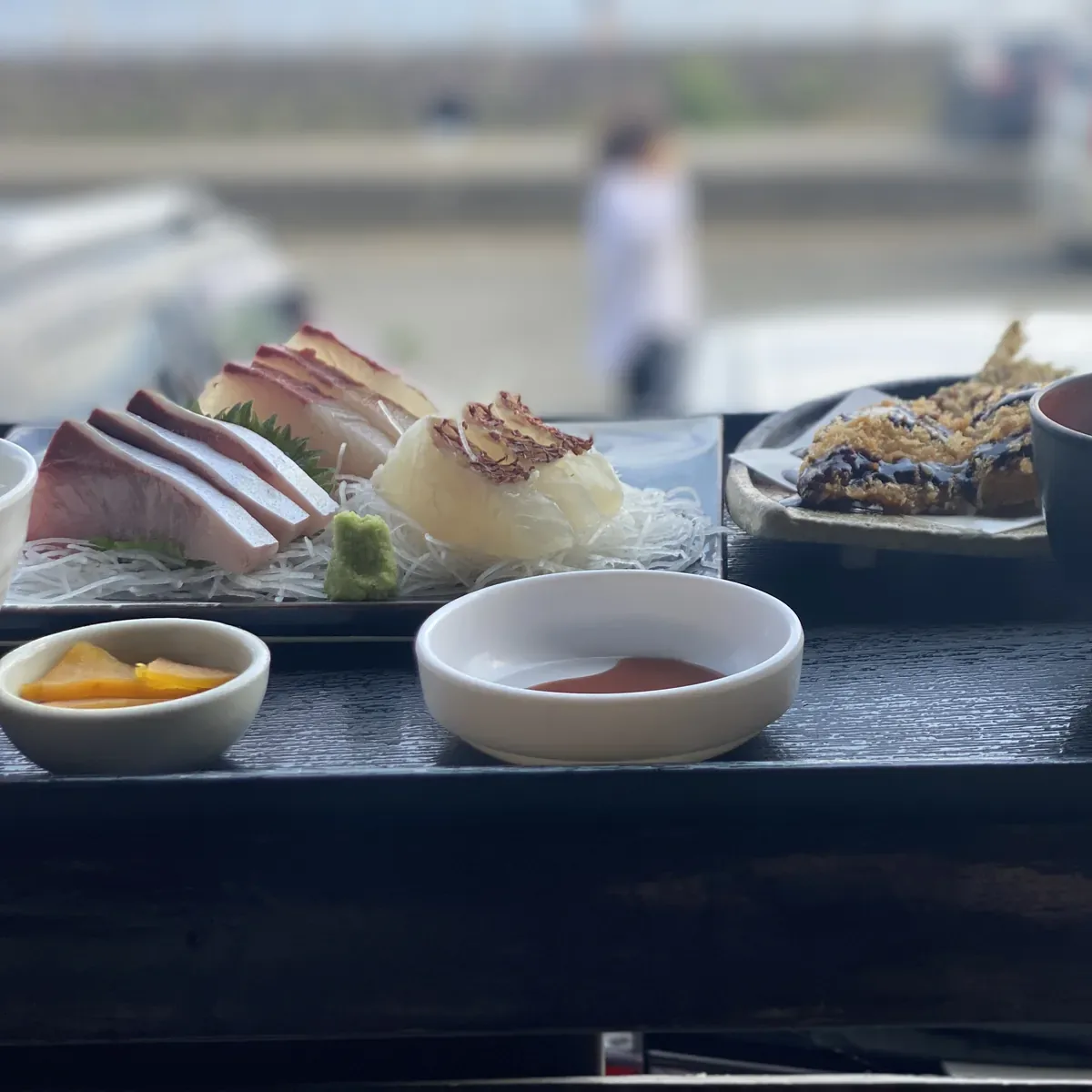
Between the hills and the bay
Yugawara sits between the outer rim of Hakone and Sagami Bay, and its kitchen follows both. Plum trees flower on the slopes below Makuyama in February, citrus ripens on the terraced hillsides for most of the year, the set nets off Fukuura fill with horse mackerel and mackerel, and in winter wild boar from the hills turns up on the odd snack menu. Part 1 of this series covered the town's citrus, persimmons, loquats, and chestnuts. This part is the calendar: what each season brings, and where you can eat it.
Almost none of it is free for the taking, and that is the most useful thing to know before you come. The trails ask you not to pick anything, most of the shoreline is under fishery rights, and the fruit belongs to farmers. In Yugawara you eat wild food through the people who catch, grow, and cook it: at the Sunday market, the harbour canteen, the farm shop, the town's mikan picking, and the bars and restaurants that buy licensed game.
Why you eat it through people
Start with the hills. Yugawara Town's hiking page describes the grassland course on the foothills of the Hakone outer rim, around Makuyama and Nangō, as a treasure trove of sansai, the wild mountain vegetables of spring, with wildflowers in season. The same page asks hikers to take their rubbish home and never collect or capture plants, birds, animals, or insects. Both are true at once: the town is proud of what grows there and wants it left where it grows. Enjoy the sansai from the path, and eat it at a restaurant or buy it from a stall, where someone who knows the plant has done the picking and the preparation.
There is law behind the request as well. Yugawara is one of the towns the Ministry of the Environment lists as part of Fuji-Hakone-Izu National Park, and in a national park's special zones, collecting or damaging plants designated by the minister is regulated. Kanagawa Prefecture also names Okuyugawara Prefectural Natural Park among the parks where such acts need permission. Anywhere in the hills, Japan's Forest Act can treat taking forest products without permission, sansai and mushrooms included, as forest theft. Picking fruit from someone else's tree is theft under the Penal Code, with a penalty of up to ten years' imprisonment or a fine of up to ¥500,000.
The plants are the other reason to leave them. In April 2025, people in Kanagawa were poisoned after eating aconite mistaken for nirinsō, an edible wild green, and the prefecture's advice is blunt: never pick, eat, sell, or give away a plant you cannot identify for certain. Across Japan over the past ten years, poisonous plants and mushrooms caused about 0.8% of food-poisoning patients but 21 deaths, about 48.8% of all food-poisoning deaths. The shore has its own rules. Common fishery rights cover almost all of Kanagawa's coastal waters, and abalone, turban shells, wakame, kombu, spiny lobster, and octopus taken by anyone outside the fishing cooperative may infringe those rights. The prefecture's own short film on the rules of rock-pooling is below.
Video
Kanagawa's rules for rock-pooling
An episode of Kanagawa Prefecture's own news programme on what you may and may not take from the shore. In Japanese.
Produced by: Kanagawa Prefecture ↗
The year, season by season
Winter is citrus, game, and then plum blossom. JA Kanagawa Seishō, the farm cooperative for western Kanagawa, ships open-field mikan from mid-November to early March. Kanagawa's hunting season runs from 15 November 2026 to 15 February 2027, and deer and boar hunting outside hunting reserves continues to the end of February 2027, an extension that covers parts of Yugawara. The prefecture's fish list puts flounder in season from December to February. Then the plums open. The Yugawara Plum Grove at Makuyama has about 4,000 red and white trees, and the next Ume no Utage runs from 6 February to 7 March 2027, with entry at ¥300, free for town residents and anyone staying overnight in Yugawara. Our plum blossom guide has the walk.
Video
The plum grove and Ume no Utage
A film from the Yugawara Town tourism section's channel on the plum grove at Makuyama and its festival.
Produced by: Yugawara Town Tourism Division ↗
Spring is Shonan Gold and the season of sansai. JA ships Shonan Gold, a citrus bred in Kanagawa, from mid-March to mid-April. The prefecture lists red sea bream in season from February to May, horse mackerel from March to August, and shirasu whitebait from April to December, the last two landed along the Sagami Bay coast. Spring is also when the foothills fill with sansai, and April was the month of Kanagawa's aconite case, so spring greens belong on a plate someone else has filled.
In May the mikan trees flower: Yugawara's volunteer guides say the blossom opens after the Golden Week holidays and lasts until late May. From late May to late June, JA ships ume from the Odawara and Ashigara area, grown mainly around the Soga plum grove in neighbouring Odawara; that window is the region's, not a Yugawara figure. Loquats ripen in early summer too, and Part 1 covers them. One thing to remember: ripe loquat flesh is safe to eat, but the agriculture ministry warns against powdered loquat seed.
Summer brings fish and the first mikan. Greenhouse mikan from Odawara and Yugawara, mostly the early Miyagawa variety, ships from mid-August to early October, when there is little other citrus about. On the bay, the prefecture lists goma mackerel from June to August and true mackerel from August to February, landed off the Miura Peninsula and the Sagami Bay coast, alongside the horse mackerel and shirasu of spring.
Autumn is picking season. The town's mikan picking runs from 10 October to 17 December 2026, and private cars cannot drive up to the orchards; our mikan picking guide has the prices and how to get there. Persimmons and chestnuts here are mostly garden trees, as Part 1 explains, and the town asks owners to harvest early, because about 30 Japanese macaques live around Yugawara. On 15 November the hunting season opens again, and the year comes round.
The sea: Fukuura's set nets
Fukuura, at the western root of the Manazuru Peninsula, is Yugawara's fishing port; its address is Yugawara, not Manazuru next door. Yugawara's volunteer guides, writing for the Kanagawa Tourism Association, say that before dawn the boats come back with horse mackerel, mackerel, sardines, squid, and the fish of the season, and that 96% of the catch comes from set nets, fixed nets that wait for fish to swim in. So the best calendar for Fukuura is the day's menu: what lands depends on what the sea brought past the nets that week.
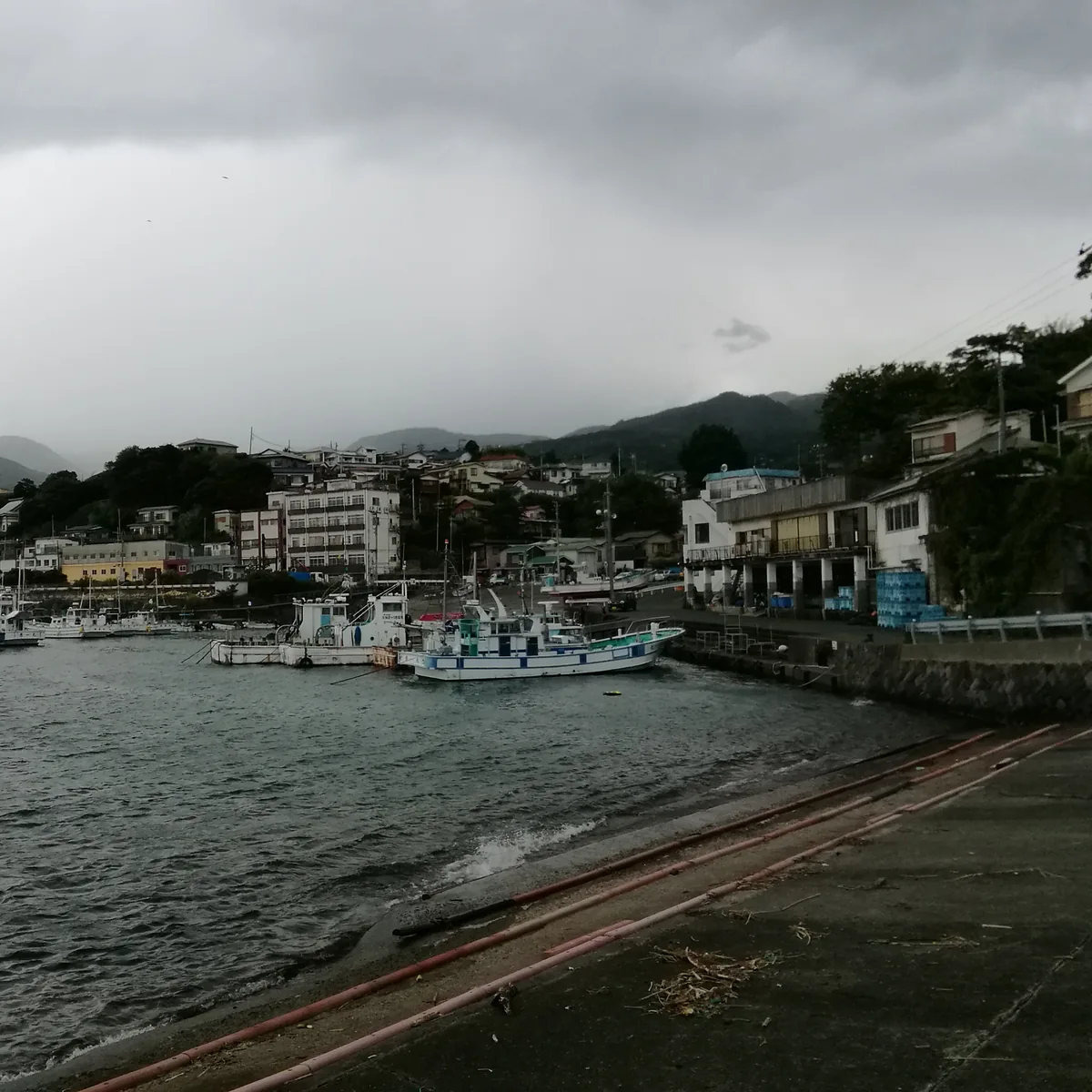
The place to eat it is Fukuura Minato Shokudō, a set-meal restaurant run by the Fukuura fishing cooperative. The guides describe it as a renovated fishermen's hut with a menu set by the day's catch, and it turns 15 in November 2026. It is open from 11:00 to 15:00, last orders 14:30, and closes on Wednesdays, plus a Wednesday and Thursday together twice a month, so call ahead, and bring cash. For fish to take home, the Sunday morning market runs every Sunday from 6:00 to 9:00, rain or shine, and sells cheap dried fish made from fish caught right off the town.
Boar on the menu
Wild boar is the hills' other harvest, and in Yugawara it starts as a problem for farmers. The town runs boar capture with the hunters' association and local farmers, and says that setting a trap needs the town's permission and a trap-hunting licence, so leave traps alone if you find one. Our wildlife stories follow that work, from the seven boar catchers of Kawabori to swine fever in the town's wild boar, which does not infect people.
Getting a boar from a trap to a plate is harder than it sounds. A restaurant that serves game has to buy meat butchered at a facility licensed for meat processing under the Food Sanitation Act. The agriculture ministry's list of game processors, which it says is not complete, has eight in Kanagawa, and the nearest to Yugawara are in Hakone and Odawara; none has a Yugawara address. The health ministry warns that raw or undercooked wild deer and boar can cause food poisoning from hepatitis E, E. coli, and parasites, and says to cook it through to the centre. In town, Beer Stand Kadoya by the Ochiai-bashi bus stop serves venison jerky and wild boar sausage with its craft beer.
Where to eat it
Put together, a year of eating wild in Yugawara is a short list of places. The Sunday morning market has dried fish and the season's citrus. The JA farm shop No. 1, at 4-1-1 Chūō, is open on Mondays, Tuesdays, Thursdays, and Saturdays from 8:40 to 16:00, closing at 12:00 on Saturdays and on public holidays. Minato Shokudō has the catch, the town's mikan picking fills the autumn, Makuyama Park is where the plums are in February, and Kadoya is the stop for boar with your beer.
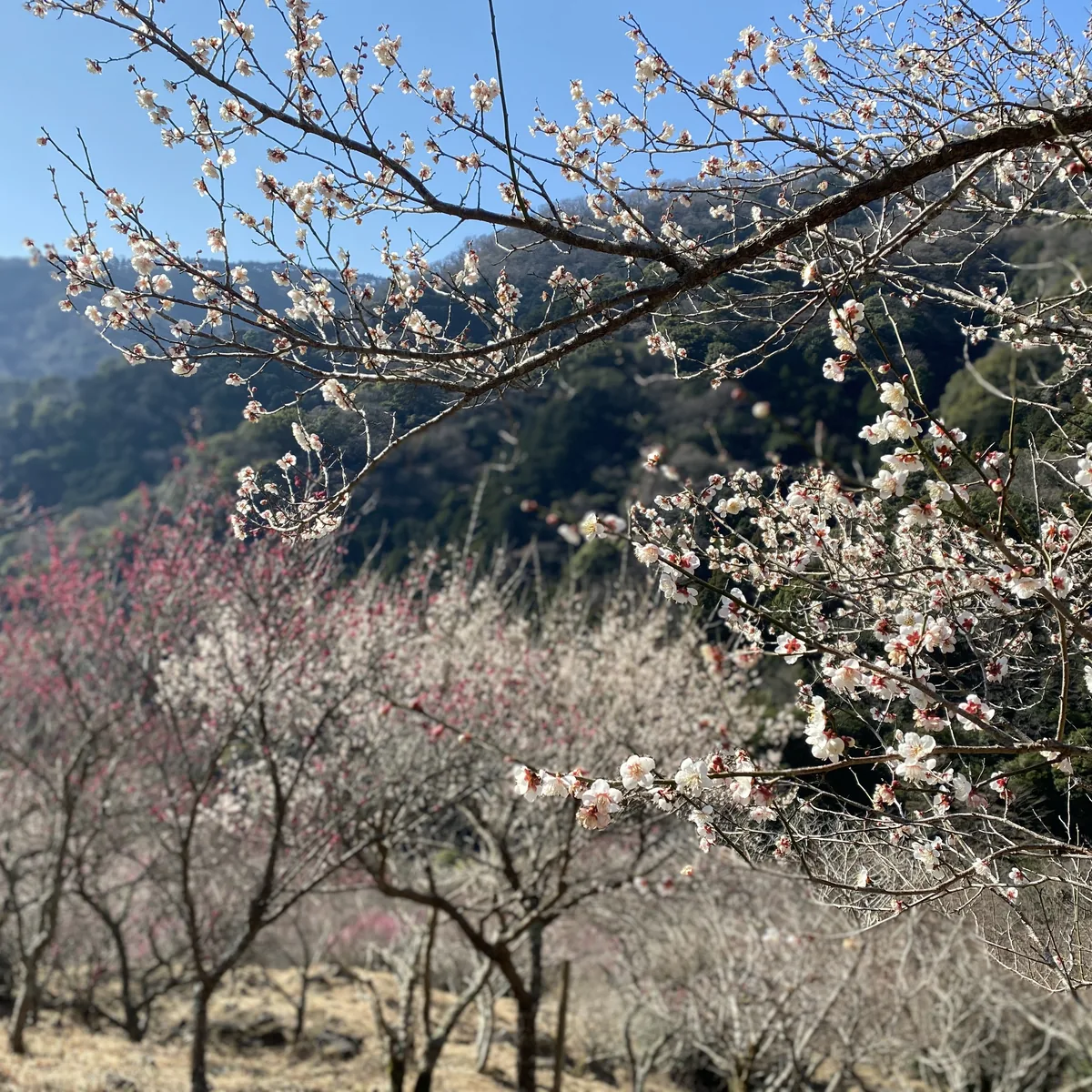
None of it needs a basket or a field guide. The hills keep their sansai, the shore keeps its abalone, and the people of the town do the catching, growing, and cooking. What you bring is timing: February for the plums, autumn for mikan, and any morning the boats have been out for the fish.